The Origin of the 45-70 Government Cartridge by John Knight
The .45-70 Government Cartridge
Good fortune has put into my hands two very important books for the trapdoor collector. The first
is Ordnance Memoranda No. 15 and the second being the report to Congress from the Secretary of War in
1873, Messages and Documents. Both were shortened to O.M. 15 and M & D plus their page numbers.
The first topic to be covered will be the origin of the .45-70 Government Cartridge and its internal
chamber, bore and twist of the 1873 Springfield rifled musket.
The O.M. 15 contains the minutes of the Ordnance Board of 1872, whose orders were to recommend a breech
system for adoption by the War Department. Appended to this Board, headed by General Terry, was a
board that, through a series of experiments, was to find a small arms caliber to recommend to General Terry's
Board. This round would then be used in each of the breech systems being considered by General Terry's
Board on breech loading small arms.(1)
The ordnance officers who would conduct the search were: Major J.G. Benton, Major T.J. Treadwell, and
First Lieutenant William Prince. (2)
This ordnance board was to conduct a series of experiments and determine a proper caliber for small
arms.(3) The experiments considered 40, 42, and 45 calibers with numerous forms of barrel
and ammunition. (4)
From the Minutes of Lt. Prince
On July 8, 1872, the board met for the 42 caliber, straight chambered rifle, with 18" twist. Cartridges
charged with 70, 75, and 80 grains musket powder and a 370 grain-cannelured round nosed lead bullet
lubed only in cannelures.
Test firing was 20 shots at 500 yards with each charge. Cleaned barrel between targets. 70 grains
worked best with 80 grains going "quite wild." The whole trial indicated insufficient lubrication
due to shallow cannelures.
On July 9, 1872, the 42 caliber cartridges with deeply cannelured bullets having been prepared as
ordered were fired 20 shots at 500 yards with a mean deviation of only 9.26".
Modification of the Model 70 Rifle that occurred as the experiments proceeded were sometimes
cosmetic, ie - the barrel was contoured to the new round maintaining the wall thickness found on the .50-70.
Another was milling the lock plate thickness to the
beveled edge. These would have reduced weight.
The process continued from May 14, 1872, to January 31, 1873. On this date each of the three officers on
the board were to express their opinions based on the results obtained in the trials. The resolution
would be to determine a proper caliber for small arms that would also involve rifling and chambering,
as well as all essential features of the ammunition.
The board's conclusion was that the caliber should be 45 with 70 grains of powder (musket) sized grain.
The bullet would be 12 parts of weight lead and one part of tin, a hard bullet alloy. Five rectangular
cannelures cut .075" deep separated from each other by a space of .050" wide. The overall bullet length
would be 1.11 inches. The bullet diameter was .458" and a weight of 405 grains. The lubricant in the
cannelures only was 8 parts of bayberry-wax and one part graphite. This was ammunition #58.
It is interesting to note that the first ordnance reference of drift towards rifle twist due to
shooting an elongated projectile is mentioned, but not resolved.
Barrel #16 was 45 caliber. From breech face to muzzle it was 32.5 inches. It weighed 3 pounds,
9 ounces. The rifling was three plain concentric grooves equal in width to the lands and cut .005" deep
with a uniform twist of one turn in 22 inches. The chamber was 2.165" in total length. The flange seat
(rim width and depth) was .645" by .065".
The chamber from the flange end was .508" and at the muzzle end of the chamber it was .482" then .065"
of bore taper from .482" to .450". Barrel #16 with ammunition #58 consistently out performed all other
combinations. At 500 yards the deviation was 8.8". The penetration at 500 yards with hardened 405 grained
bullets was 8.8" of pine boards. Thus, the three ordnance officers by extensive testing had arrived at a
consensus of "suitable" caliber.
For those who would like to pursue Ordnance Memoranda Issue 15, it is available from Amazon in Scholar
Select reprint - hardbound - with no fold out drawings for about $40 delivered.
1- O.M. pg 5
2- M.D. pg 383
3- M.D. pg 381
4- M.D. pg. 386
Remington and Hartley & Graham Produced Trapdoor Rifles for Public Sale
The following comments and data are from Ed Hull’s research into the Hartley and Graham records.
As you probably know, Hartley and Graham was a large outfitter and seller of guns that they purchased
or had made by their gunsmiths. Note, most of the trapdoor altering came after trapdoor production was
halted at Springfield Armory except the ones assembled from unserviceable parts from the M79 turn-in of guns
with SN's less than 50,000.
Trapdoors with 5 Groove Barrels
It is more likely that the trapdoors with barrels having 5 groove rifling are from aftermarket/assembled
rifles from New York dealer Hartley & Graham (H&G). These barrels have the large V/P/eagle, but are
missing the last p. That means the barrels were never fitted with a receiver and tested at Springfield.
On Sept. 28, 1894, H&G wrote to their warehouseman, “We are sending you 580 Springfield barrels 45 cal.,
unfinished, bought from Whitney. Please look these over, and ship them to The Remington Arms Co., Ilion, NY,
whom we have instructed to put through with the lot they are now working on for us, and to make them into
regular 45 caliber finished barrels.”
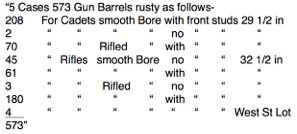
On October 9, the following was shipped to Remington Arms Co. from the “Whitney Lot:”
 |
|---|
In the time period January through October, 1895, H&G issued their gunsmith William Coxford a total of 1,522
“Sets of parts 45 c.f. for Springfield B/L [breechloading] Rifles.” Of these, 48 sets were for cadet rifles.
By year’s end, Coxford delivered them back as completed rifles in lots of 100.
From these entries we can see that:
1. H&G was having a variety of unusual trapdoor rifles, in both cadet and full length, made up by their gunsmithing firm.
2. H&G was having the Remington Arms Co. make and finish rifle barrels. At that time, Remington was using 5-groove rifling in
their own rifles, so it is likely that they did the same here. No record has been found of how many rifle barrels Remington
was making in the on-going deliveries noted in the first memo above, so only the 316 rifle barrels listed in the second entry
are documented. Thus, Remington produced at least 316 barrels with 5 groove rifling, and likely many more.
As a further note, in an “Estimate of Arms assembled & refinished…May 1st 1882 to May 1st 1893,” H&G had the following rifles
made up from parts (probably from the 1879 turn-in of rifles and carbines with SN’s less than 50,000):
1,340 Springfield B/L carbines 45 cal
3,263 Springfield B/L Cadet Rifles 45 cal
5,120 Springfield B/L Rifles, 45 cal
600 Springfield B/L Sporting rifles
(This may be the source of the early carbines with the brass sliding door in the butt)
In a follow-on “Statement of Arms made from stock…. May 1st, 1893 to date June 9/96,” H&G lists:
3,975 Springfield B/L rifles 45 cal assembled from parts + Refd [refinished].
In yet another follow-up “Statement of Arms made…June 9th 1896 to Jany. 1st 1898,” there were made:
200 Springfield B/L rifles 45 cal assembled from parts
256 Springfield B/L Cadet Rifles 45 cal assembled from parts
Thus, Hartley & Graham made up, and sold as “new,” thousands of trapdoor rifles which today give collectors fits in identifying them.
The H&G records go so far as to specifically list 2-click and 3-click tumbler variations, and “old model” (M1873) rear sights,
“Buckhorn” sights and “new model” (Buffington) sights. And not all of the parts were Springfield Armory surplus — their gunsmiths
could make up any part(s) that were required to complete a whole rifle.
So, that prize, “experimental” or “transition” rifle you have in your collection may not be an authentic Springfield Armory product.
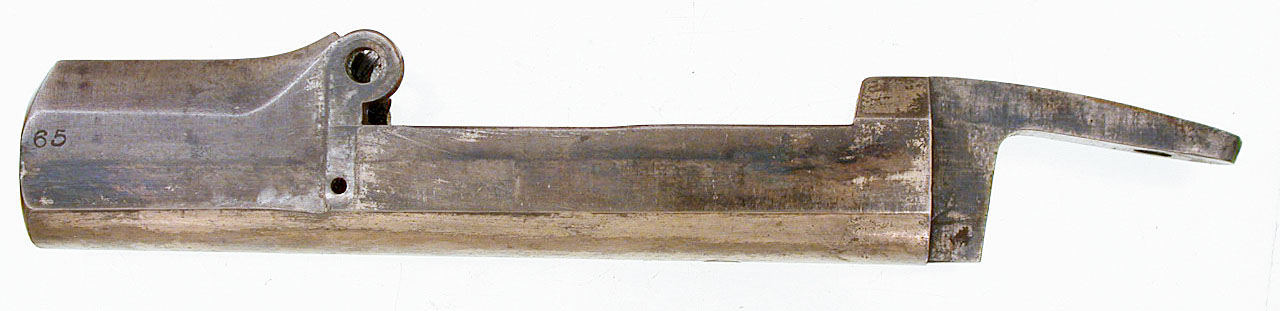
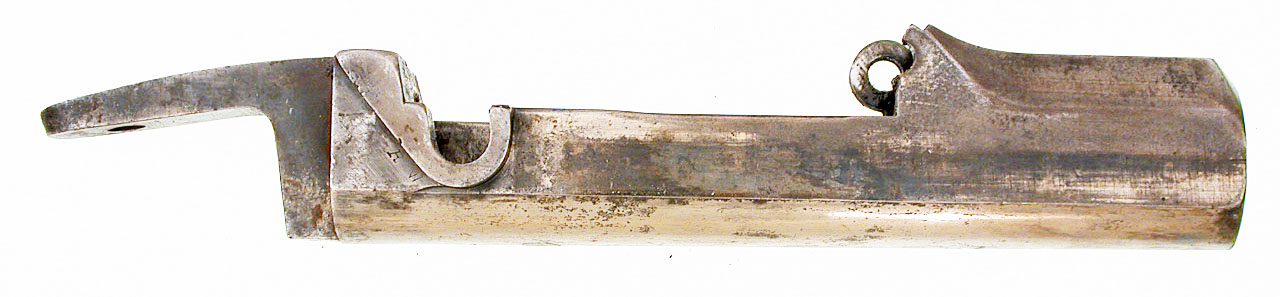
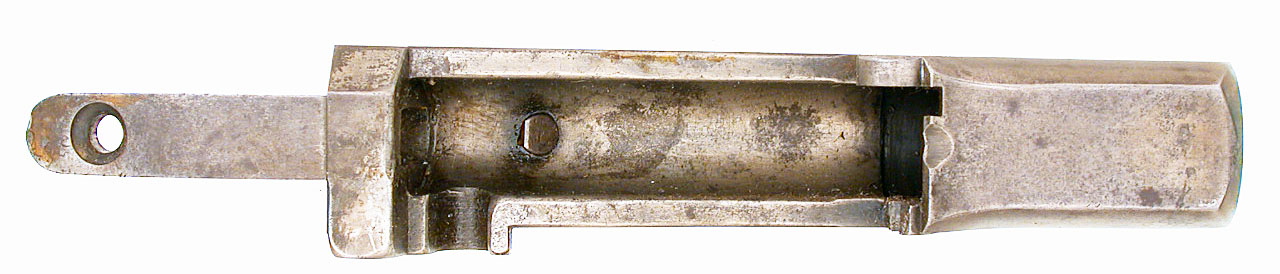
An M68 Receiver SN65 That Indicates Unlocked Firing. One of the hinge mounts is missing and the other shows a crack at the base.
 |
|---|
 |
 |
The End of a search, 1868-dated Model 1868 Rifle, serial number 62
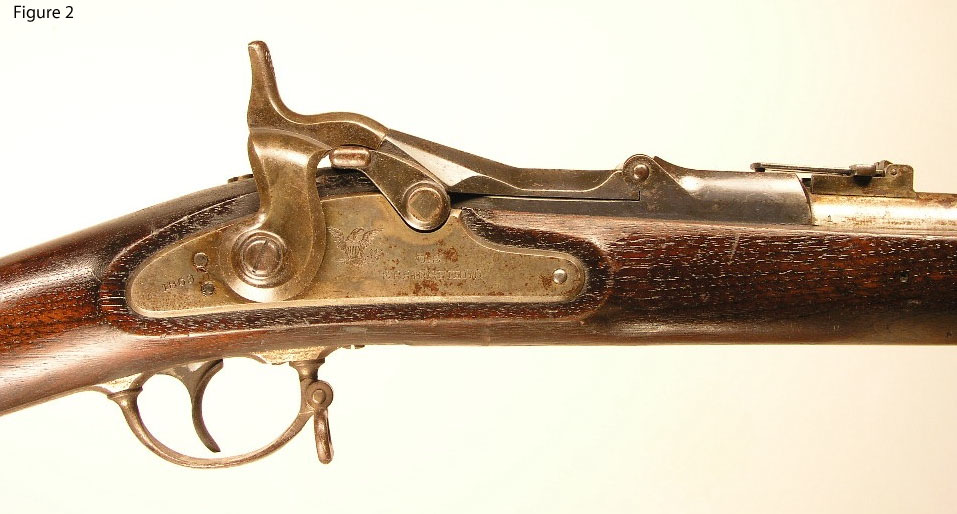
The end of a search, 1868-dated Model 1868 Rifle, serial number 62
|
|---|
|
|
|
|
|
|
|
When I began collecting trapdoors in 1970, I started a big binder of all sorts of notes, articles, pictures, etc. One of the very first items I ran across was an article by the late Graham
Burnside, in the May 1966 issue of "Shooting Times". Not surprisingly for the times, prior to the explosion of such knowledge in the 1980s, there are a few - but only a very few - errors;
the early Model 1870s, without "Model" and having single-shoulder rods, are not mentioned, for example.
Graham and I had corresponded off and on in the mid-1950s, about cartridge collecting, when he was a teacher in Illinois, and
I was in high school in California.
That article was my very first primer on the .50-70, and one of the illustrations showed three very nice Model 1868s side-by-side,
one for each year made. For some reason, that image has remained in my mind for nearly 45 years, but at the time I did not realize
just how scarce the 1868-dated specimens really are, or how long it would take (if ever) to find one.
Approximately 52,000 Model 1868 rifles were made, of which about 16,000 were dated 1869, and about 36,000
were dated 1870.
The few 1868 dated guns are, for all practical purposes, statistically non-existent. The 1870-dated versions are, with GREAT
frequency, mis-identified as Model 1870 Rifles (a somewhat scarcer type) by parties who never read beyond the price.
Fast forward to Al's second volume, and later his Newsletter, wherein he presented information about the few known "1868"
specimens, one being #63, and requested help (which never materialized to any great degree, due, no doubt, to the fact that
almost no one had such a piece!) in determining the salient features.
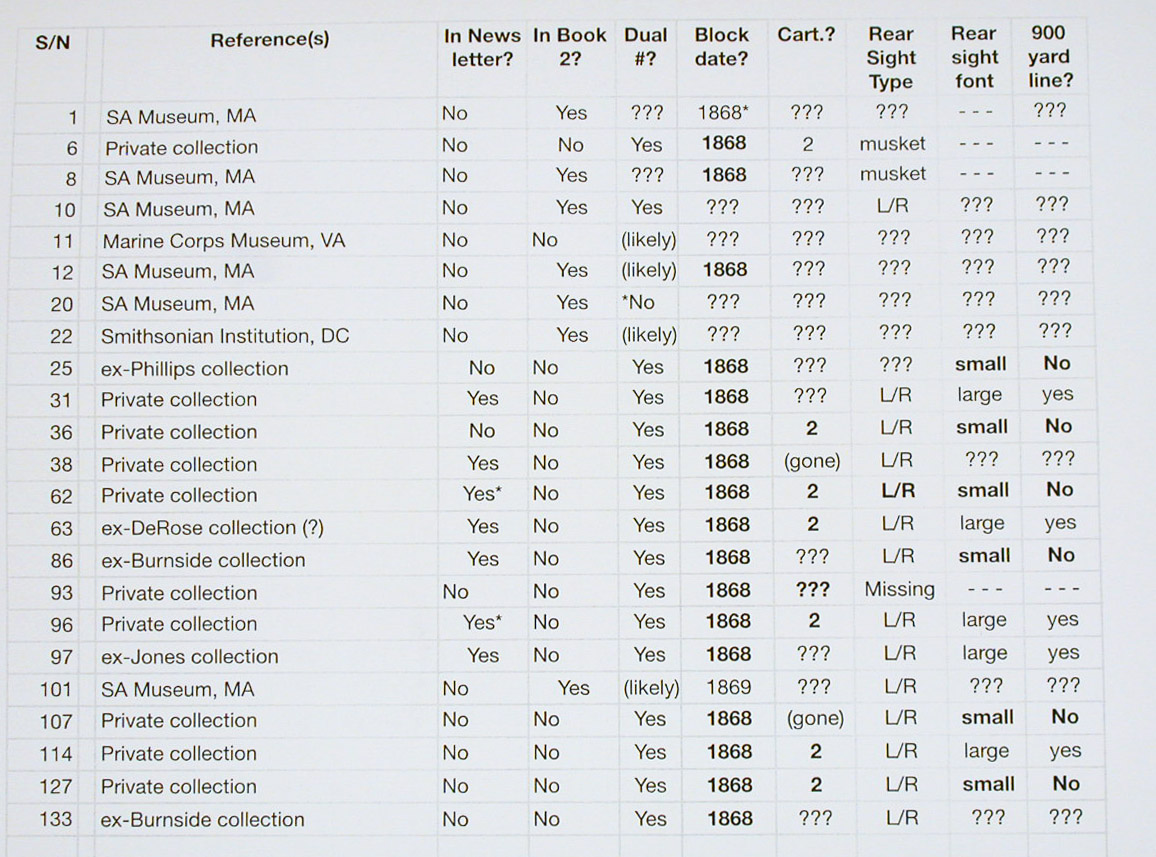
Expanding upon his fine start, I have recently made up a new chart (Fig. 1) bringing all of the seventeen (17) presently-known
specimens into one table, including recently found #62 (Fig. 2). Unfortunately, a possible 18th specimen recently had to be
dropped from consideration when it was discovered to have a short receiver.
Eight of the rifles are in museums (mostly at SA) and nine are in private hands. There are notable absences in some very
well-known collections, including that at USMA, West Point. The Smithsonian has one, as does the USMC museum at Quantico.
Doubtless there are still a few standing, unrecognized and unappreciated, in closets across the country, but there cannot be
very many. Collectors would be wise to carefully inspect any model 1868 that they happen to encounter.
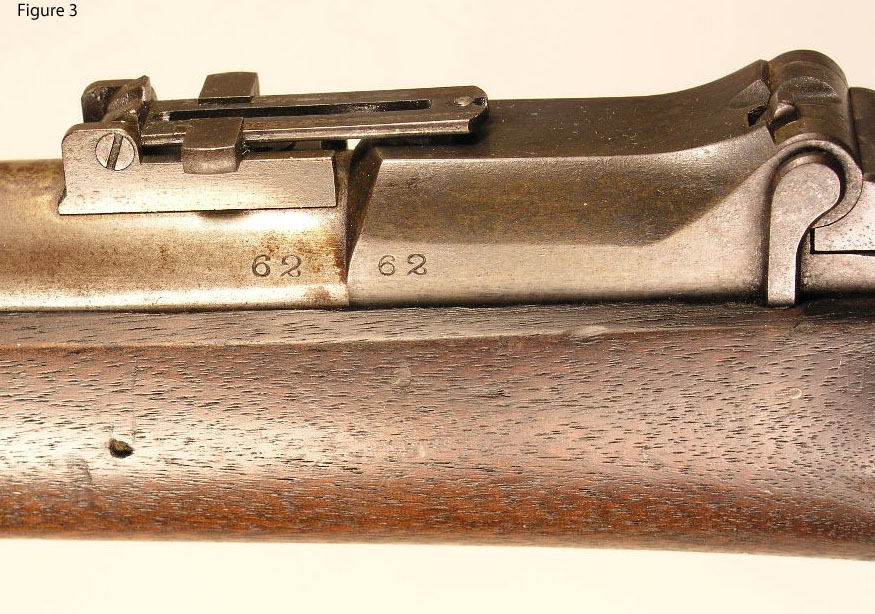
Serial numbers (Fig. 3) appear in at least two differing forms. The very earliest examples have small, bold, completely vertical
digits, with plain serifs. At some point, as yet unknown, the numerals increase slightly in size, and become a bit thinner,
just slightly off-vertical, and have fancier serifs. Once you have seen this font, you will never forget it. Anomalies, and
"out-of-expected-sequence" examples are known - these were basically "test" guns, probably not intended for field issue.
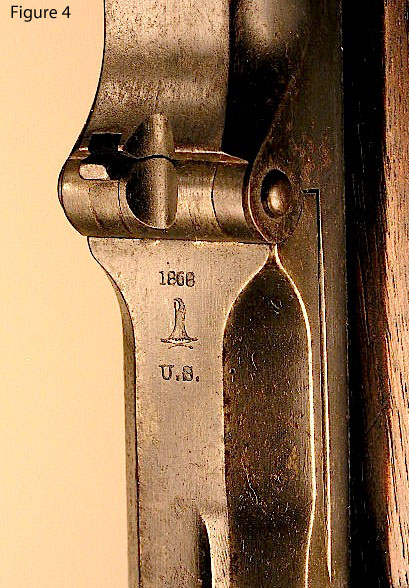
Aside from the low numbers, assumed not to exceed 150 or so with the earliest-dated block, the breechblock stamping itself
(Fig. 4) presents the most obvious difference. Close inspection of several pictures reveals that (a) the text is slightly
smaller than on later guns (b) the eagle head is distinctly different, being very similar to the 1866 style (c) the overall
height of the inscription is substantially greater, and (d) the lettering is frequently unevenly struck, and not always
aligned perfectly parallel to the hinge pin. Note lack of extractor damage, indicating low usage.
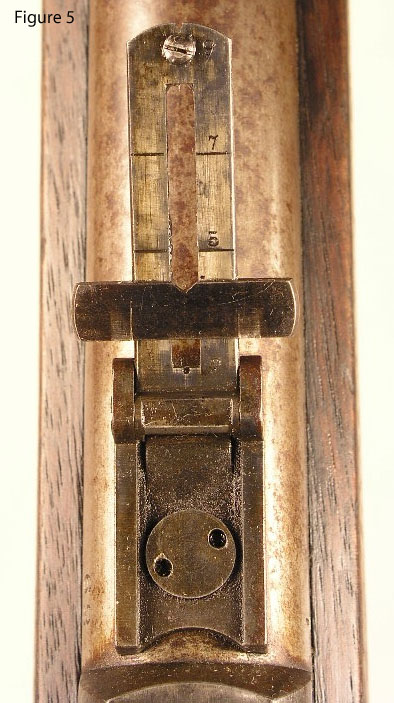
A totally unexpected discovery was made while restoring the missing rear sight slide. The leaf of #62 is graduated
differently (Fig. 5) than that of all previously known M1868 rifle sights! There is no 900 yd. line, and the
figure
'9" is up by the top notch. The 700 and 500 yd. lines are each approximately 1/10" higher on the leaf than usual
(examples of all arms using this sight were carefully measured). Further, the digits are in a noticeably smaller
typeface than standard. The assumption is that this sight was a very early experimental variant. If anyone else has a
similar one, we would like to hear of it.
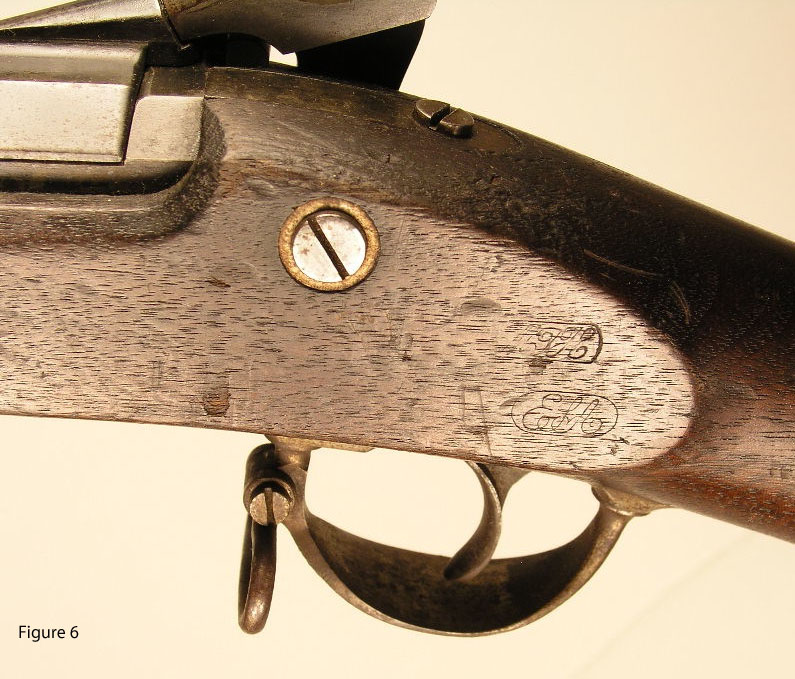
Other features include a reworked musket stock (M1863 type 1) with only two (Fig. 6) cartouches, in regions three and four.
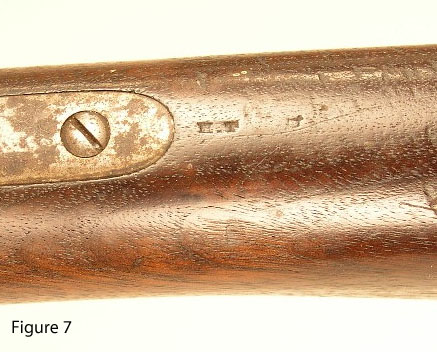
A pair of small initials (H.T. or N.T.) occur, in-line, just behind the trigger guard (Fig. 7). The firing proof is
sometimes absent, and does not occur on #62. The spoon should be in place, though primary rod retention is achieved by
the new rod keeper at the upper band.
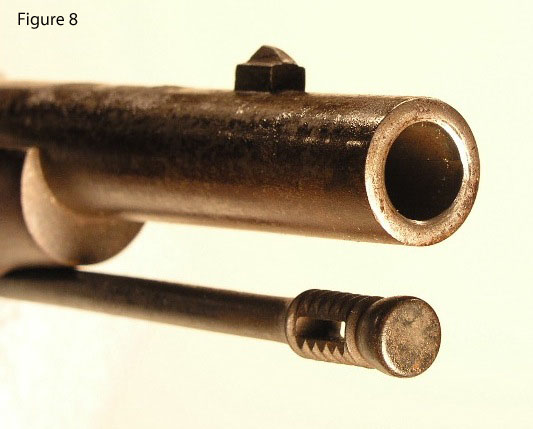
Barrel should be solid, not lined as were those of the Model 1866 Allin conversions. This requires a close look at the
muzzle (Fig. 8) where many Model 1868 rifles show battering from the single rod shoulder, which can mimic a liner joint.
If lined (which would be "wrong") the tell-tale ring of braze should also be visible.
As always, additional input is welcomed - if you have a specimen of this model, or if you wish to comment upon any part of the foregoing, or have any questions, let us hear from you. (Dick Hosmer - RichardAHosmer@comcast.net)
Capt. Charles E. Bendire's Sporting Rifle .
Al. Finally got the pictures of the Sporting Carbine that Capt Charles E.
Bendire ordered from Springfield Armory on Sept. 4, 1874, and rec'd at
Jefferson Barracks, St Louis, Mo on Sept 30, 1874,
before he departed to the west from his stint on recruiting duty at
Jefferson Barracks. This pre officer's model sporting carbine is
mentioned on pages 116, 124, and 184 of Book II, The 45-70
Springfield 1865-1893. This carbine was purchased from a garage sale
picker that turned it up in late November in Seattle, Washington.
Capt. Bendire came from Germany and entered
the lst US Dragoons, and then as an Infantry Officer during the Civil War,
and then moved back over to his old unit, the lst US Cavalry, in 1864 and
served with it until he was discharged
in 1886. Brevetted for gallantry in 1890 for his service during the Indian Wars
in the Nez Perce Campaign in Montana in 1877. Capt Bendire was a life time
naturalist and ornithologist
and upon his discharge, became the head of the Ornithology Department at
Smithsonia where he donated and organized his 8,000 bird eggs and nests
he gathered when serving throughout
the west during his military career. In 1896 Smithsonia published his
definite two volume set of books on Bird Game of North America. He passed away
in 1897. Many of his bird articles
are still in print 116 years after his death. A remarkable trapdoor that
belonged to a remarkable US Dragoon and US Cavalry officer. Hayes Otoupalik Collection.
.jpg)
.jpg)
.jpg)
.jpg)
.jpg)
.jpg)
.jpg)
.jpg)
Here are some of the rifle's details:
The wood is bural and checkered on the wrist and forearm.
There is no cartouche and no circled P on the stock.
There is no saddle ring bar and ring.
The barrel is 26-inches long.
The screws are slotted in the sight base.
Standard slider on the 73 carbine rear sight.
There is no serial number on the receiver as it is floral engraved.
It is not a set trigger system
|
|---|
|
|
|
|
|
|
|
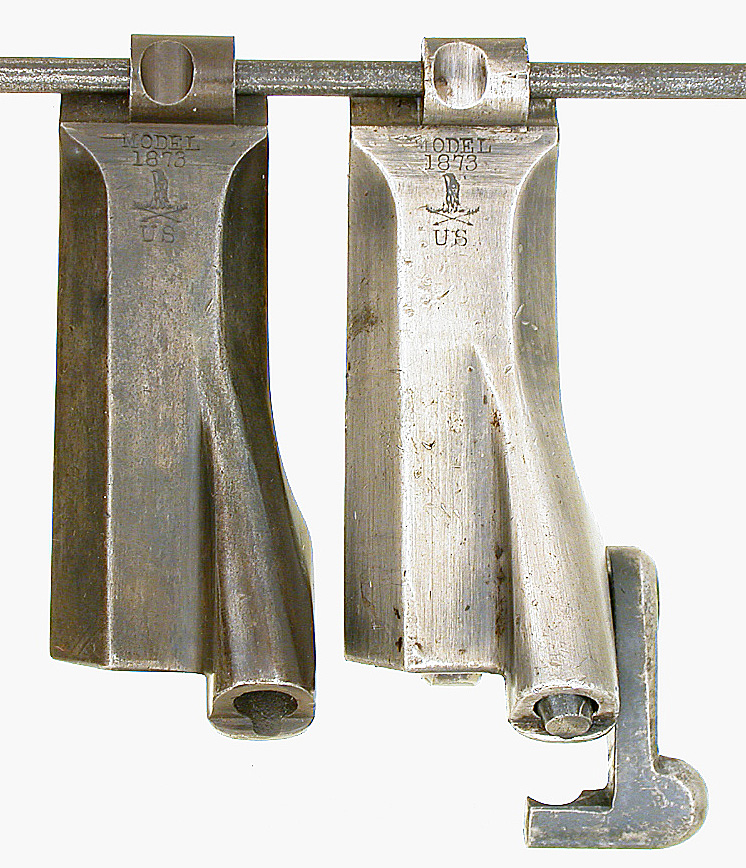
Very Early M73 Breech Blocks
This early modification was first noticed by Richard Hosmer.
The following photo illustrates the difference in the two blocks. Notice the difference in the vertical mill cut to the right side of the block. In the top photograph it is identical to that of the M68, M69, and M70 blocks. On the later M73 blocks, the mill cut is significantly higher. We believe the change to the taller cut occurred around SN30000, but that is yet to be determined. Any help you can give to clarify this transition would be helpful.
 |
|---|
Chicago City Police M66 Rifles
INFORMATION SUPPLIED BY Bruce Green at policebruce1@verizon.net
CHICAGO POLICE TRAPDOORS In 1874 a group of industrialists, professionals, and social activists formed the Citizens. Association of Chicago to correct conditions in that city that had been highlighted by the disastrous fire of 1871. Following initial successes, this association formed separate committees for the Fire Department, Police Department, sewers, water supply, architecture, etc. as an adjunct to the elected municipal government. In John Flinn.s 1887 .History of the Chicago Police., page 130, he describes the police loss in this 1871 fire, among other equipment, ..muskets to the number of 620, $8,680;.six brass cannon... On page 208, documenting conditions within the police department in 1877, he states: .There was in possession of the department this year a quantity of arms, purchased by the Citizens. Association, consisting of four twelve-pound and two six-pound guns . one ten barrel Gatling gun . 296 Springfield breech-loading rifles, and 60,000 rounds of ammunition. These arms, equipments and ammunition were held by the department with the understanding that they were to be returned to the association at the demand of the executive committee. The department had also at this time 102 Springfield rifles of its own, which had been purchased by citizens and presented to the police.. During the 1870.s, the Chicago police were formally known as the Chicago City Police, .C C P., note enclosed tintype of a Chicago police officer with the well known .C C P. belt buckle. In the December, 2001 issue of the Gun Report, noted authority Mike Carrick, Staff Editor, posed his own question concerning an 1866 Model Allin conversion, lock plate dated 1862, 2 band, 32 ½. barrel, 18 5/8. between bands, front sight 1 ¼. back from muzzle, hinge strap stamped .C A. and on the receiver in place of a later serial number .C C P.. The number .111. was stamped on the top of the comb forward of the butt plate. The slot for the middle band retaining spring was filled-in, professionally done so as to be barely visible. After correspondence and phone calls, I purchased Mike.s trapdoor and began researching same, uncovering the history of the Citizens. Association of Chicago. In the February, 2011 catalog of a recognized, national firearms auction company, a similar Model 1866 Allin conversion with 2 bands and a 31 1/8. barrel was advertised with .C C P. stamped on the receiver but no .C A. on the hinge plate. This rifle was stamped with the number .76. on the top of the comb ahead of the butt plate. The photo that accompanied this auction item seems to indicate that the middle band was intact with the muzzle area not in the photo. I also have in my collection another Model 1866 Allin conversion, lock plate dated 1864 (the .4. is very shallow), barrel shortened to 31., with middle band intact and the front band removed (and altered stock professionally shortened). The receiver is stamped .C C P. in place of later serial numbers but no .C A. on the hinge plate. It has the number .7. stamped on the top of the comb forward of the butt plate. It also has what appears to be .W 101. stamped on the right side of the butt. It has been nickel plated, probably for later parade or honor guard use. This should explain .C C P. stampings on the receivers of approximately 400 Model 1866 shortened conversions as long as the stock numbers fall within the recorded inventory totals of 296 provided by the Citizens. Association (.C A.) and the 102 previously in the police. hands (no .C A.).
State Arsenal Holdings and Requests for Sp-Am War Arms
INFORMATION SUPPLIED BY CHARLES PATE at cpate4@cox.net
Records related to the Spanish-American War (3 inches)
Letters and telegrams from state AGs in response to call for troops for the Spanish-American War
and COO inquiry regarding the status of the states, arms and equipment. Most contained request
for
uniforms and equipment and many did not give details on their arms. Notable documents:
SC-- Had 2047 Springfield rifles (Trapdoors)
ND-- Had 350 Springfields and wanted 300 more
WI-- Had 4000 Springfields and 100 .38 caliber Colts
FL-- Needed 220 Springfields and 75 more Colt .45 revolvers
MS-- Had only 300 serviceable Springfields
AR-- Had 700 Springfields
IA-- Asked for 1500 Springfields
TN-- Had 1050 Springfields
MO-- Had 1080 Springfields (models 73 and 84) and 23 Colt .45 revolvers
KY-- Had 800 Springfields, wanted 3000 more and 200 Krag carbines and pistols
PA-- Had 7500 Springfield rifles and 360 carbines
MN-- Had 1790 Springfield rifles and wanted 1810 more
CO-- Had 1058 Springfield rifles, 140 carbines and 140 Colt .38 revolvers. Wanted another 58
Springfield rifles.
LA-- Had 1500 Springfields
Capt. James Rockwell, Jr. was Chief Ordnance Officer, 1st Army Corp at Chickamauga. A Chief of
Ordnance letter to him referred to a telegram from General Brooke dated 6/17/98 that had stated
the condition of the volunteer regiment's arms was very poor and that 14189 of them were
doubtful. The COO stated it would be impossible to replace all of them and cautioned Rockwell
about condemning arms.
NY State Vol. for Sp-Am War
1st NY Vol. Infantry Hawaiian Islands May 1898 . Feb 1899
2nd NY Vol. Infantry USA May 1898 . Nov.1898
3rd NY Vol. Infantry USA May 1898 . Dec 189
8th NY Vol. Infantry USA May 1898 . Nov 1898
9th NY Vol. Infantry USA May 1898 . Nov 1898
12th NY Vol. Infantry Cuba May 1898 . April 1899
14th NY Vol. Infantry USA May 1898 . Oct 1898
22nd NY Vol. Infantry USA May 1898 . Nov 1898
47th NY Vol. Infantry Puerto Rico May1898 . March 1899
65th NY Vol. Infantry USA 1898 . 1898
69th NY Vol. Infantry USA May 1898 . Jan 1899
71st NY Vol. Infantry Cuba May 1898 . Nov1898
201st NY Vol. Infantry USA July 1898 . April 1899
202nd NY Vol. Infantry Cuba July 1898 . April 1899
203rd NY Vol. Infantry Usa July 1898 . March 1899
Troop A NY Vol. Cavalry Puerto Rico May 1898 . Nov 1899
Troop C NY Vol. Cavalry Puerto Rico May 1898 . Nov 1899
4th Light Battery NY Vol. Art. USA July 1898 . Oct 1898
5th Light Battery NY Vol. Art. USA July 1898 . Oct 1898
7th Light Battery NY Vol. Art. USA July 1898 . Nov 1898
Model 1868 Rifles Issued to the Navy
From Charlie Pate: Al, for the last few years I've been going through the Chief of Ordnance records page-by-page. I'm getting into 1871 now for the registers and saw the following. Thought you might be interested. The Navy not only had some Trapdoors, they had them on a pretty famous ship.
12/9/1871 - RG156, E20, #5337: Commodore Case, USN Bureau of
Ordnance, asked for 12, Allyn Breech Loading Rifles be supplied the Navy
for the gunnery practice ship, Constellation.
Early M75 Rifles
The early Officer's Model have the following features that I had not previously recorded. (1) The number on the inside of the trigger bow matches the numbers on the inside of the trigger plate and internal parts. (2) The 50 yard mark is on the early M75 rifles, but on the right side with the other range markings, (3) The trigger plate does not have the fine engraved line on the edge. (4) The engraving on the trigger bow is not quite what you expect compared to later ones. (5)The number on the inside of the trigger bow is the same as the number on the inside of the trigger plate and the set trigger main spring. Some of the smaller parts have only the last digit stamped on them. All are the same font. (6) You can tell the early ones by the modified Sharps tang sight and the barrel is void of stamps or it only has the small v/p/eagle stamping. The last p is missing.
Texas Ranger Trapdoor Carbines
The following list of carbines put into service between September 1, 1876 and 1878 are listed below. This list comes from the article, TEXAS RANGER TRAPDOORS, Co.F Frontier Battalion, 1876 Issue Records and Beyond by Don Jones. The article was published in the Fall issue of the Texas Gun Collector.
32325 ------ 41168
34126 ------ 41321
35351 ------ 41351
35360 ------ 41368
35388 ------ 41541
35390 ------ 41544
35397 ------ 41568
35444 ------ 41832
35474 ------ 43208
35520 ------ 43451
35540 ------ 70880(8)
35560 ------ 80238
35572 ------ 80244
35574 ------ 80259
35609 ------ 80297
38029 ------ 81240
------------- 103810
Look carefully at the number sequences and it is clear that these carbines are from partial shipping crates indicating the clustered SNs were received at the same time. Email Don Jones at DJNJPI@aol.com
Unfinished and Damaged Springfield Parts
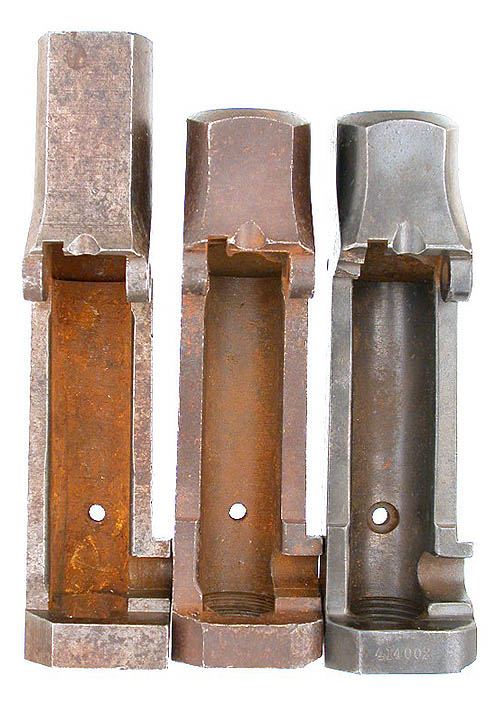
The three receivers shown consist of a damaged M73 with an "ear" broken off and an unfinished M68 and M73 receiver. The two unfinished receivers have a deep stamped C somewhere on the exterior. Neither unfinished receiver has been threaded for the breech screw or the barrel. Also, the ejector stud mount has not been finished.
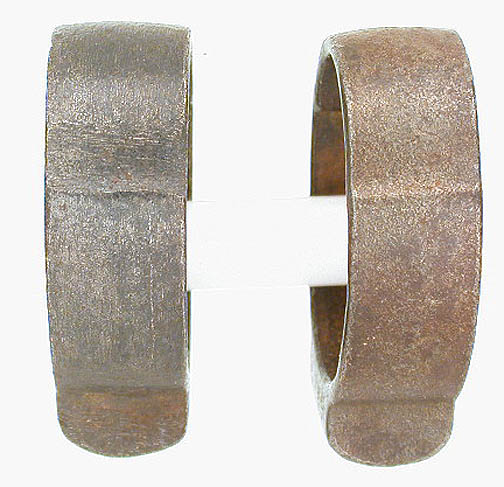
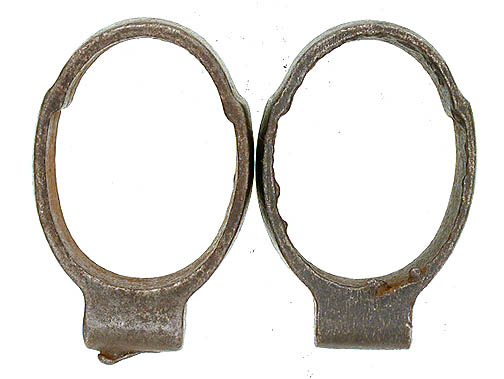
The two front bands for the M73 rifle have not been finished. Their
surface is rough and on the edges there are some spurs from the forging
process. The holes have not been drilled for the sling or stacking
swivels.
 |
|---|
 |
 |
 |
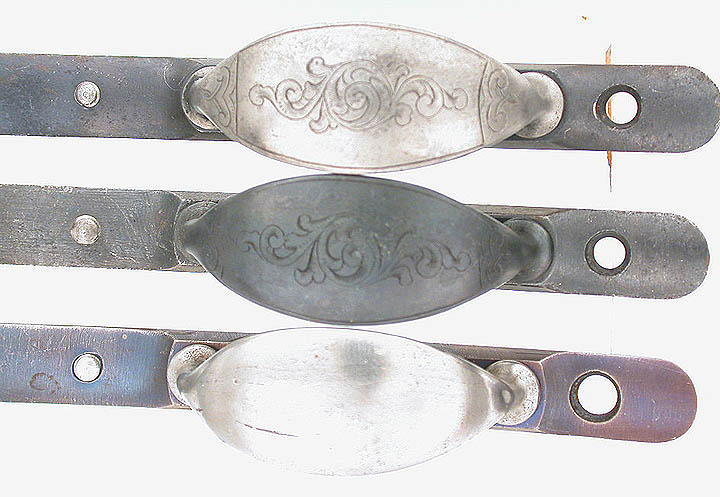
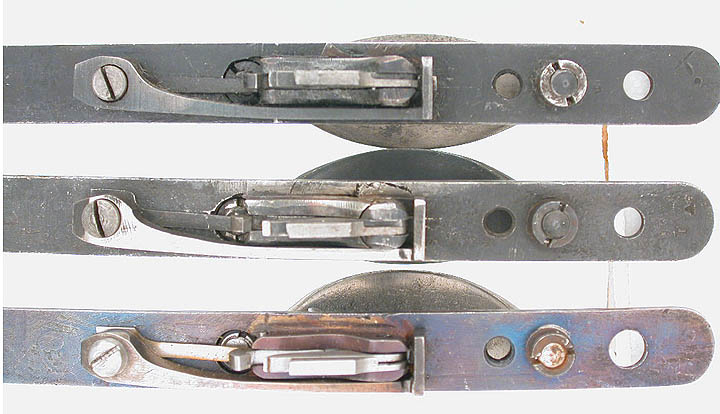
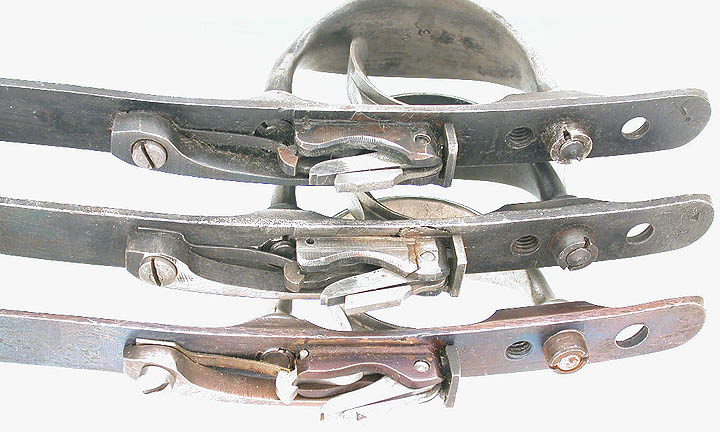
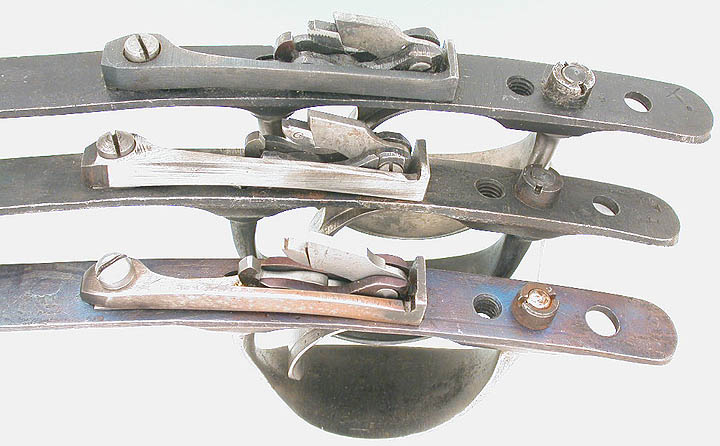
Non-Springfield M75 Set Trigger Systems
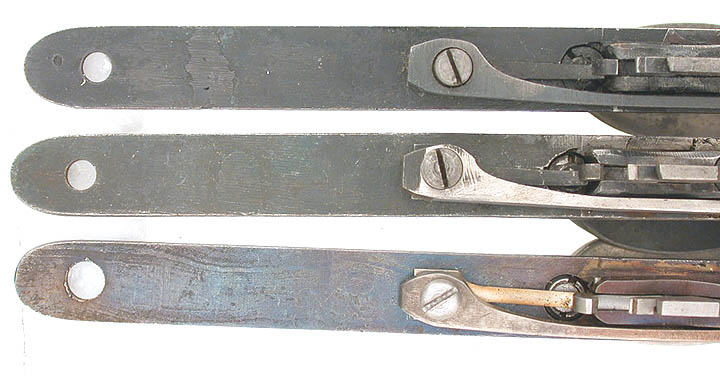
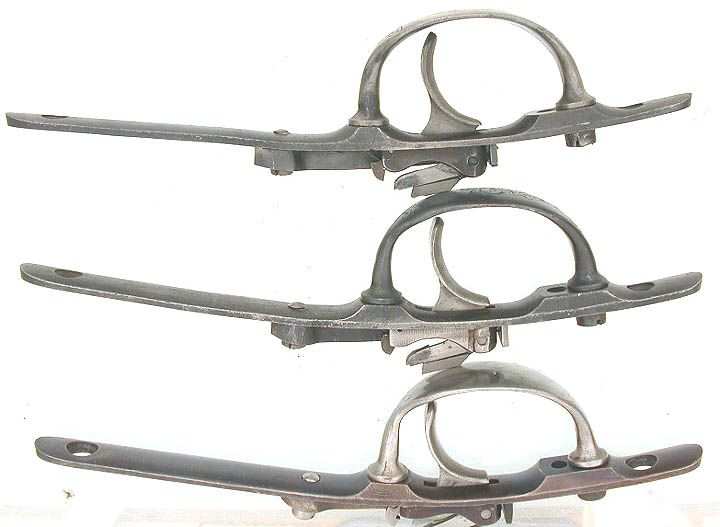
The three set trigger systems are thought to have been made by the same Pennsylvania maker. He has died recently and the systems were recently accumulated. Two belong to Ed Knisely and I own one. Look carefully at the trigger plates, two are M64s and one M63. One is drilled for Bannerman screws. The engraving is much too shallow and too fancy and with too much fine detail. Two of the trigger bows are homemade from rifle bows. The center one may be a carbine bow. The variation and crudeness of the mechanism is something noticeable. Also, the size and length of the bolt through the plate is questionable. Also, one and possibly two of the plates have been welded together.
 |
|---|
 |
 |
 |
 |
 |
Unfinished Carbine Barrel circa 1878
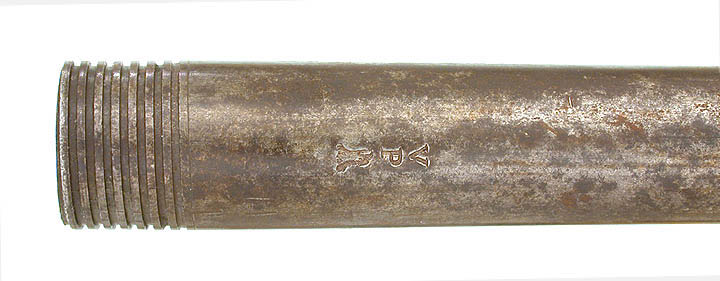
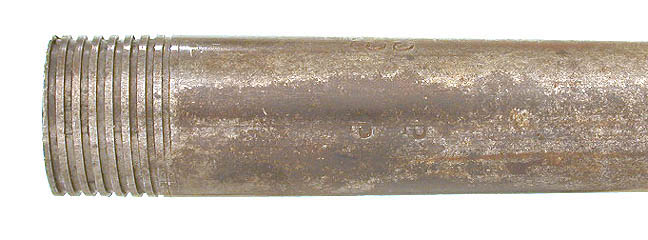
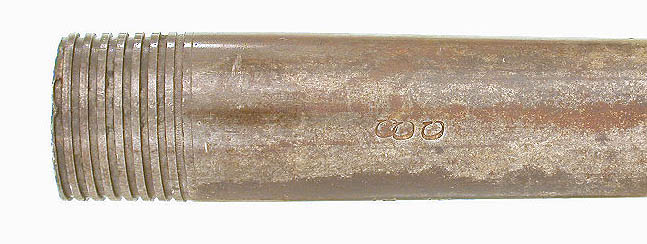
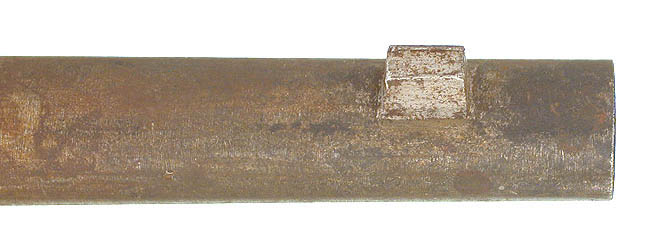
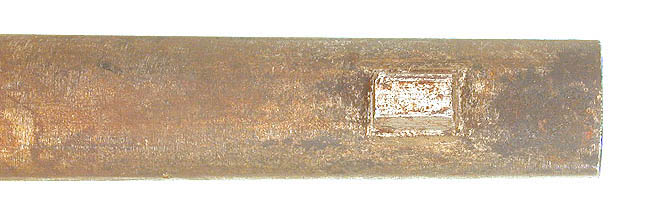
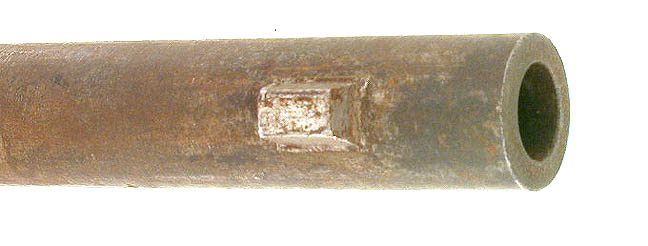
The following unfinished barrel was just recently purchased by Bill Hatch. The barrel has a number of interesting features associated with its exterior and stampings.
FIRST, the "CCC" evidently indicates the barrel has been condemned.
SECOND, The barrel had been test fired twice and passed both burst tests as indicated by the "P P" stamping on the underside. This stamping was used from about SN65000 to SN160000 or from the period 1876, to 1880.
THIRD, The "V/P/Eagle head" is on the barrel. OM22 indicates this stamping was not done until the front sight and the exterior of the white barrel were found to be satisfactory. Hmmm???
FOURTH, the barrel is about 0.004" too large in diameter indicating that surface filing was needed. There are several slag pits in the surface of the barrel that are deep enough to not be removed in the finishing process.
FIFTH, the threads on the barrel are for screwing the barrel into the gang firing fixture for the burst testing.
SIXTH, the front sight stud has not been drilled or cut for the front sight blade. The top of the sight base has a small shoulder on the sides parallel to the barrel. These could have been used with a retainig tool to align the sight with the barrel.
SEVENTH, the bore is exactly 0.450, but there is quite a bit of rough surface in the bore that appears to be very deep.
See Book II pages 384-385
 |
|---|
 |
 |
 |
 |
 |
Another M68 Rifle made in 1868
George Sears has just purchased an M68 Rifle made in 1868. It has the following specifications: SN96 (barrel and receiver), 1868 dated breech block (all numbers hand stamped), 2 visible cartouches (musket cartouches in rear of stock flat), and it does have a lined barrel (the braze is visible at the muzzle). The gun is all original minus the cleaning rod. This rifle, like he others found, was made for testing and not for issue. See the Trapdoor Newsletter, page 346, for more information and photographs of these rare rifles.
U.S. Grant's Cadet Rifle:
Peter Nelson forwarded to me the following information that Charlie Pate located in the National Archives. The original copy was pretty thin, so I did not try to reproduce it.
Washington, April 13 1868
(Bvt. Maj Gen. A.B. Dyer,
Chief of Ordnance U.S.A.)
General:
I have the honor respectfully to request permission to purchase of
your Department for my own use One Cadet Rifle and five-hundred rounds of
ammunition for the same.
Very respectfully,
Your obed't. Servant,
U.S. Grant
General..............."
Charlie also went on to note that General Grant's Chief of Staff requested
a second Cadet Rifle (which I am assuming, due to the 1868 date of the
request letter and the Production Schedule Table (on Page 48 in BOOK II)
for the "Cadet Model 1866 Rifle", was most likely a Model 1866 (since
production of the new Model 1869/Type I Cadet Rifle did not start until
the July-December period of 1869, and only 2 are being shown as having
been produced in that period).
Benecia Arsenal Powder Measure:
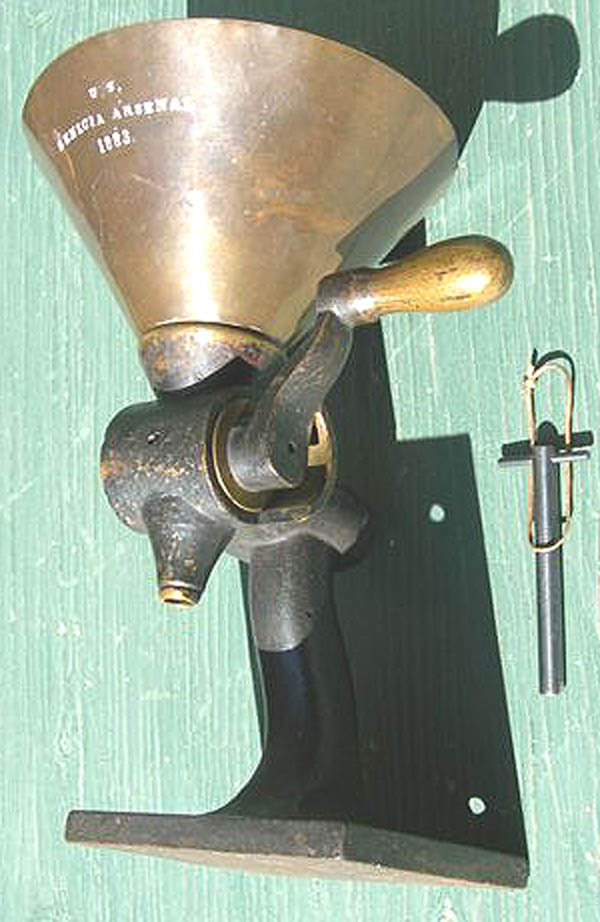
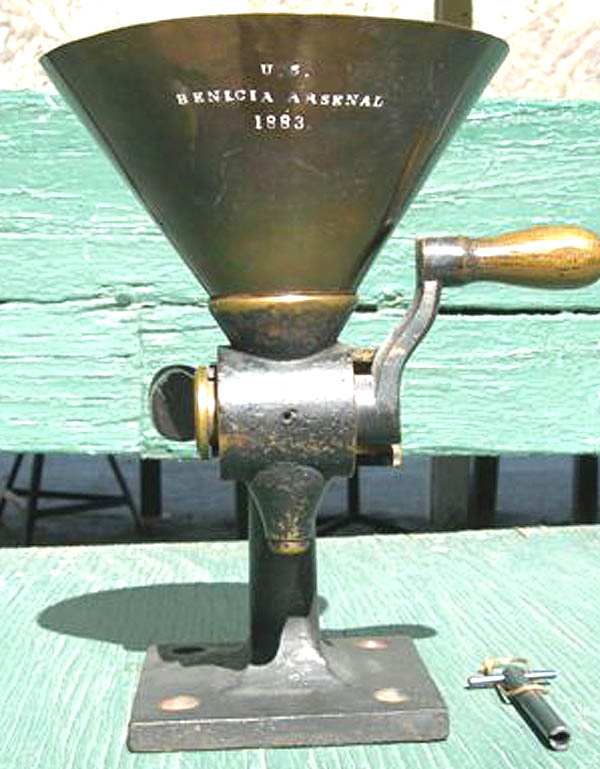
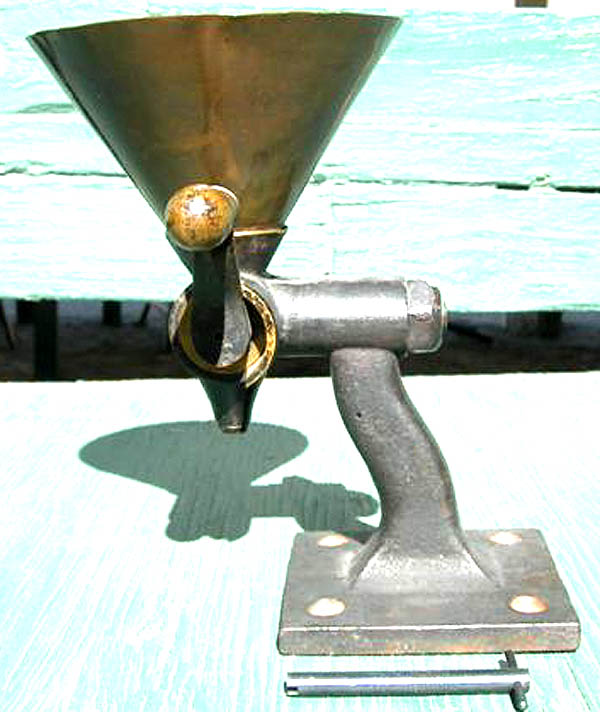
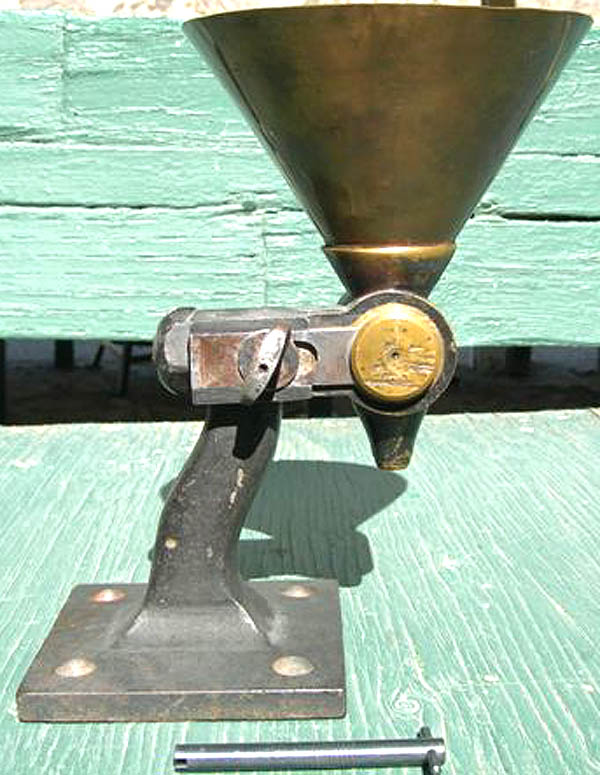
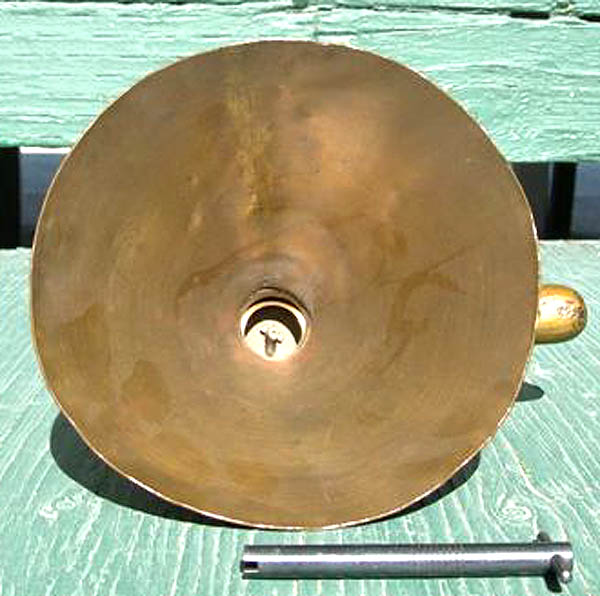
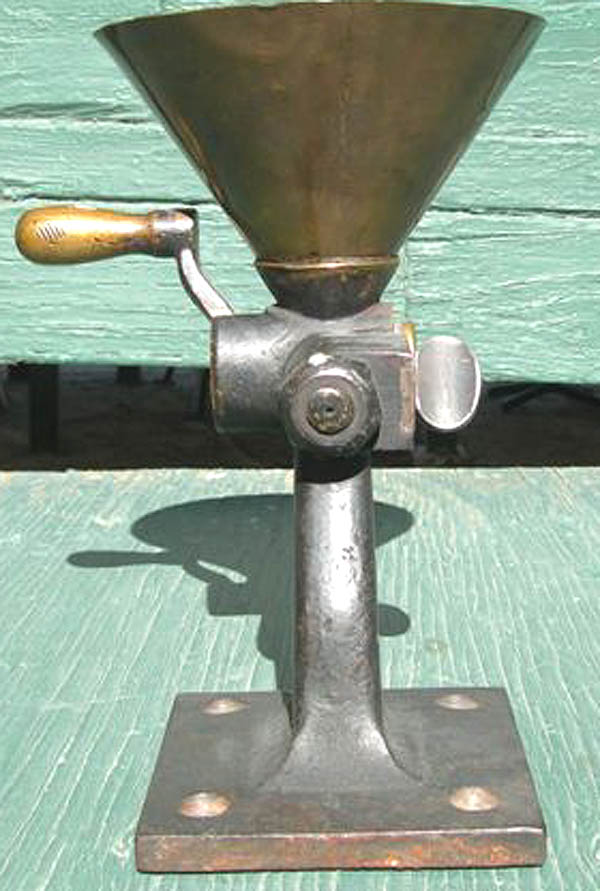
Tom Trevor submitted the following images of an 1883 Benecia Powder measure and was curious if any were made earlier? the FA ones have a steel hopper and this is brass. The small "T" wrench goes into the powder drop and by turning it clockwise or counterclockwise the powder charge can be adjusted to the charge desired, 55 carbine, 70 rifle or any othercharge they might want to experiment with. The tool has small scribe lines on it that would correspond to charges. This may have gone out shortly after the reloading sets were issued to make charging more uniform than the small scoop issued with the reloading sets. Both the scoop and the measure were designed and a patent issued to O. E. Michaelis, Ordnance Dept., on Feb. 13, 1883. See the POWDER FLASK book by Ray Rilling page 140. also see Ordnance Notes 114, 231 and 322. Tom
 |
|---|
 |
 |
 |
 |
 |
NEWSLETTER ERROR, Page 369
The listing of 1877 produced carbines either has an error in recording SN87964, or the gun has had parts interchanged. SN87964 has the cartouche with the closed 8 and serifs on the top and bottom of the 1. Also, there is a faint cartouche in front of the sling bar. There is no circled P, but the stock inspector's initial is very clear and the cartouche is deep and sharp. I am beginning to wonder if Springfield sold off all the partially completed narrow receivered guns and some company bought them and assembled guns using their own cartouche. Remember the circled R and the RGS cartouches look pretty much like Springfield work. Hmmm????
STEEL PISTOL GRIPS:
The following dimensions for the S&S Firearms repro pistol grips were supplied by Peter Nelson. LENGTH: (Along the centerline where the Grip rests on the Trigger Plate): 2.335"
WIDTH: (Measured at the widest point using a 6.00-inch dial caliper): 1.724"
HEIGHT: (measured at the highest point): 1.375"
DIAMETER OF THROUGH-HOLE FOR SCREW: 0.234" [A 15/64" (0.2343") diameter twist drill just fit through].
DIAMETER AT TOP OF COUNTERSUNK HOLE FOR SCREW HEAD: 0.392"
CHECKERED PAD AREA: 1.125" Long x 1.050" wide.
STEEL PISTOL GRIPS:
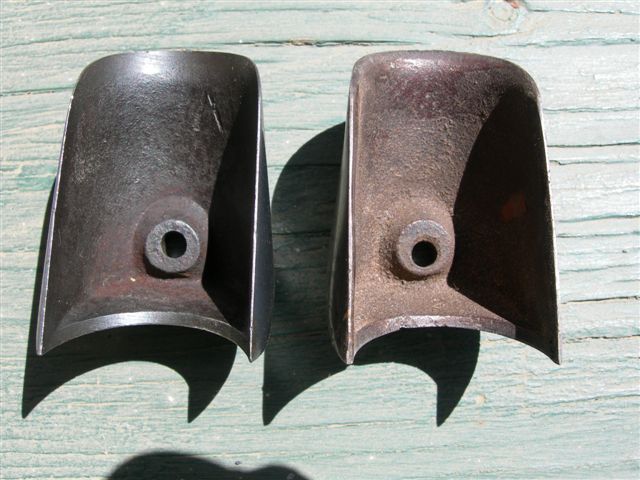
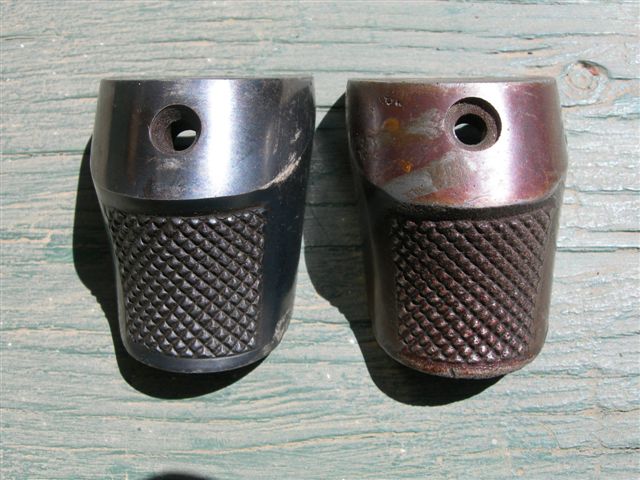
The following photos were supplied by Tom Trevor . On the left is the Springfield metal pistol grip and on the right is the Dixie Gun Works or S&S Firearms pistol grip. These repro grips have been around for at least 15 years. Note the crudeness of the casting. The original armory grips were forged.
 |
|---|
 |
STEEL PISTOL GRIPS:
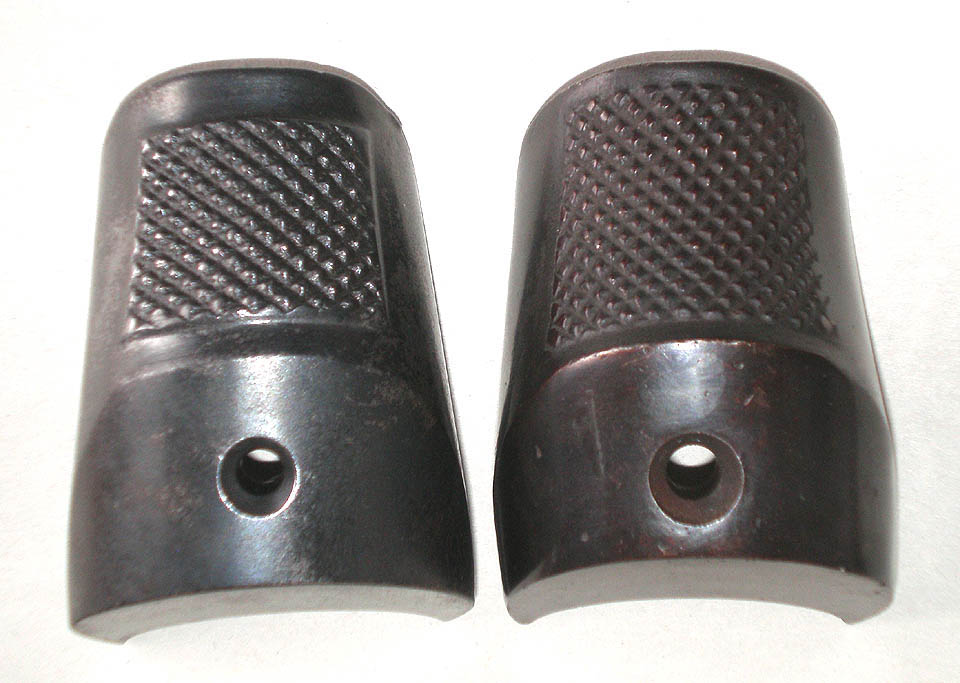
I recently bought and sold a most unusual pistol grip. The new owner, Kees Punt, has sent me images of both the standard pistol grip and that of the unusual one.
 |
|---|
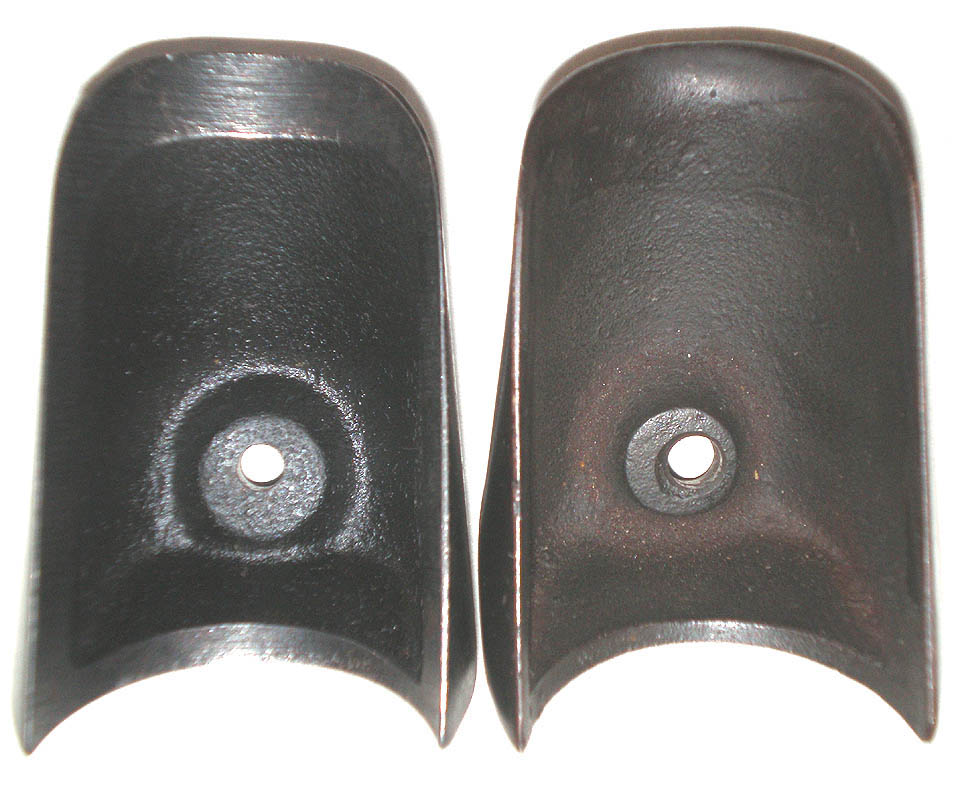 |
The grip on the right is the standard one and the one on the left is the
unusual one. Note, the hole for the retaining screw is not large enough
to pass the standard trigger plate screw. It is not clear if this was to
be a replacement for the wood Officer's Model pistol grip or if it is one
of the prototype grips that Kelton requested around 1878. If you have
additional information about this unusual grip, please contact me.
The dimensions for the two grips are given below.
The Standard Grip:
length:2.16 inch
height: 1.41 inch
width: 1.77 inch
hole for screw: 0.22 inch
area for screw head: 0.331 inch
Checkering: width 1.09 inch and length 1.13 inch
"Experimental" Grip:
length: 2.24 inch
height: 1.37 inch
width: 1.75 inch
hole for screw: 0.165 inch
area for screw head: 0.307 inch
Checkering: width 1.02 inch and length 0.972 inch
COMMENTS:
Tom: The mystery grip looks like the one Navy arms cast in the late
70s
after they got the remaining H-R stock. They put out some carbines with
the H-R OM tang sight and a metal grip. The parts all seemed to be H-R
rejects as these were the ones that often opened on firing.
Also TD Galore sells a repro grip. Just a thought.
Al: Tom, the pistol grip does not look to be cast, but forged. Does anyone have the Navy Arms rifle that Tom mentioned???